

Overview
Aligning information technology resources more strategically across campus supports the University’s mission of preparing students to be the leaders and innovators of the future. Central alignment improves efficiency and consistency in technology support, strengthens security and compliance and better stewards institutional resources in support of the University’s long-term priorities.
Technology and Innovation are key to driving our University mission now and in the future. As evidenced by recent disruptive cybersecurity incidents across higher education, it is critical that UA has enterprise-wide alignment on our information technology, data and systems infrastructure.
UA President Peter Mohler
What is Changing
- IT professionals in many areas across campus will begin reporting to the UA Office of Information Technology over the next 18-24 months. The transition will be assessed and managed through a thoughtful, unit-by-unit and position-by-position approach during this period to ensure each area’s unique needs are met, and job responsibilities are understood.
- Administrative tasks will be reduced as consistent IT practices and processes are created centrally allowing unit leaders to focus on education, research and service.
- Campus units will have more streamlined access to campuswide support for technology requirements.
- More opportunities will exist for career advancement for technology professionals across campus, which will also enhance the recruitment and retention of IT professionals at UA.
What is Not Changing
- Direct access to dedicated IT resources within your unit as well as the Office of Information Technology.
- Dedicated leadership accountable for unit IT support.
- Clear escalation paths for high priority needs.
Campus Benefits
- Improved efficiencies through collaborative use of IT personnel, resources and assets.
- Avoids duplication of services that leads to increased costs while facilitating planning and resource allocation at the enterprise level.
- Sustainable, scalable IT service foundation to support institutional priorities.
- Consistent quality and service levels in meeting technology needs, while managing risks and opportunities.
- Simplifies the user experience and improves coordination.
- Provides reliable and sustainable IT services that avoid dependency on single individuals.
- Targets long-term stability and alignment over short-term outcomes.
Thoughtfully aligning technology resources across campus strengthens the University’s ability to steward institutional resources while fostering long-term operational sustainability and effectiveness. This approach helps build a more coordinated and scalable technology support model for the future.
Executive Vice President, COO and Treasurer Dan Layzell
Timeline
| Date | Milestone | Description |
|---|---|---|
| Spring 2026 | Initial evaluation of IT services in the College of Community Health Sciences and Culverhouse College of Business | In response to personnel changes, UA OIT and Human Resources began the initiative. |
| May 2026 | Unit announcements | Unit IT personnel across campus made aware of initiative. |
| Ongoing | Unit evaluations | Refinement of roles, processes and communication/reporting structure |
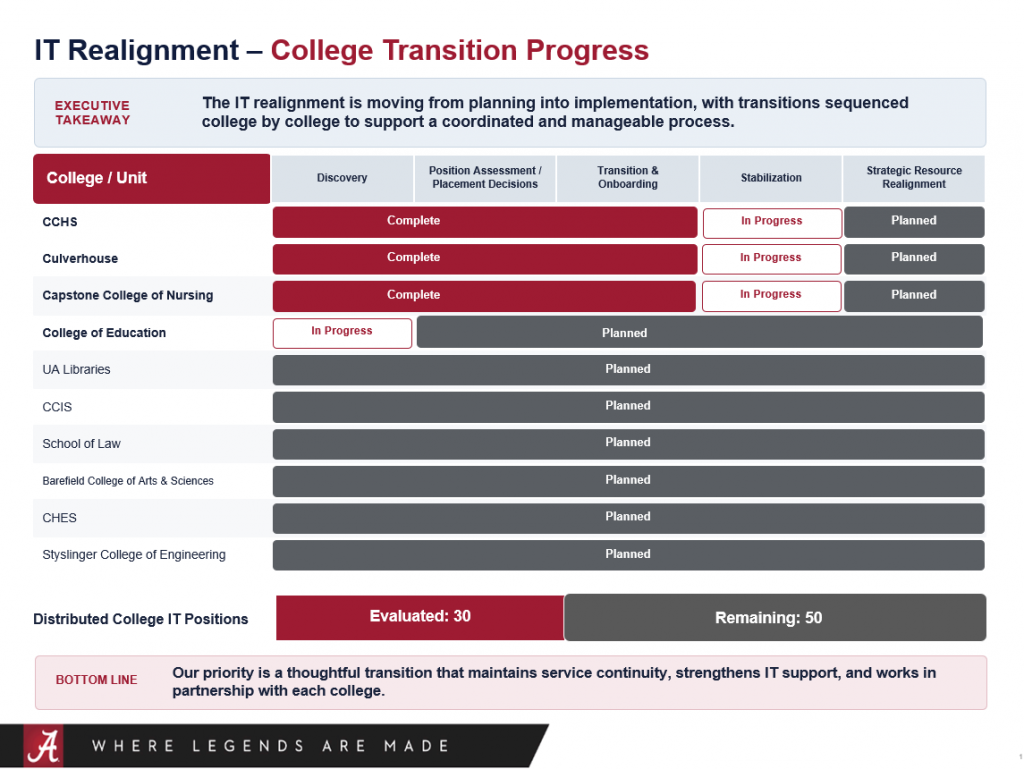
Preliminary Evaluation Sequence
OIT is currently in the information‑gathering phase of the IT realignment initiative. The list reflects initial planning and is likely to change as vacancies occur, circumstances evolve, and as we gather additional information, assess unit‑specific needs, and coordinate with college and division leadership. This preliminary order does not imply conclusions or decisions.
As information gathering progresses, OIT will publish a more detailed and up‑to‑date project plan on this site. The evaluation approach will remain deliberate, collaborative and responsive throughout the life of the initiative.
Current preliminary sequence:
FAQS
What employees are affected?
There are about 130 employees who could be affected. Areas not involved in this initiative include many auxiliary units, grant-funded units and web content managers.
Who is conducting the unit reviews?
Leadership in UA OIT along with HR professionals will work with existing unit leaders in a methodical approach to better address each area’s needs and employee responsibilities.
Who will handle IT needs during the initiative?
Units will continue using the same process as now. IT professionals will support their service areas during the realignment. UA OIT will be consistent in providing exceptional technology services and support to students, faculty and staff. Long term, there will be easier access to campuswide support for technology requirements as units onboard to UA OIT.
How does this affect current roles?
Day-to-day responsibilities for IT professionals will remain the same during the assessment period. Adjustments, if any, will be communicated after the review and assessment are complete.
Who approves my eTime and leave requests during the transition?
During this phase of the realignment, leave and time reporting processes remain in place to ensure continuity and clarity. As units move into UA OIT, affected employees will receive instructions.
Will these changes affect employee compensation or benefits?
Compensation and benefits are not impacted by the realignment. Some staff could have a change in duties or an HR reclassification as a result of the assessment. Employees will continue under existing University policies for pay, benefits and performance management.
Will staff need to relocate?
It is possible. While IT professionals will continue to support their service areas during realignment, discussions with unit leaders may result in changes. The needs of service areas will guide decision making.
How long will realignment take?
The project is planned to take 18-24 months, but the unit-by-unit approach to realignment could lead to a shorter or longer initiative so that each area's needs and employee responsibilities are addressed.